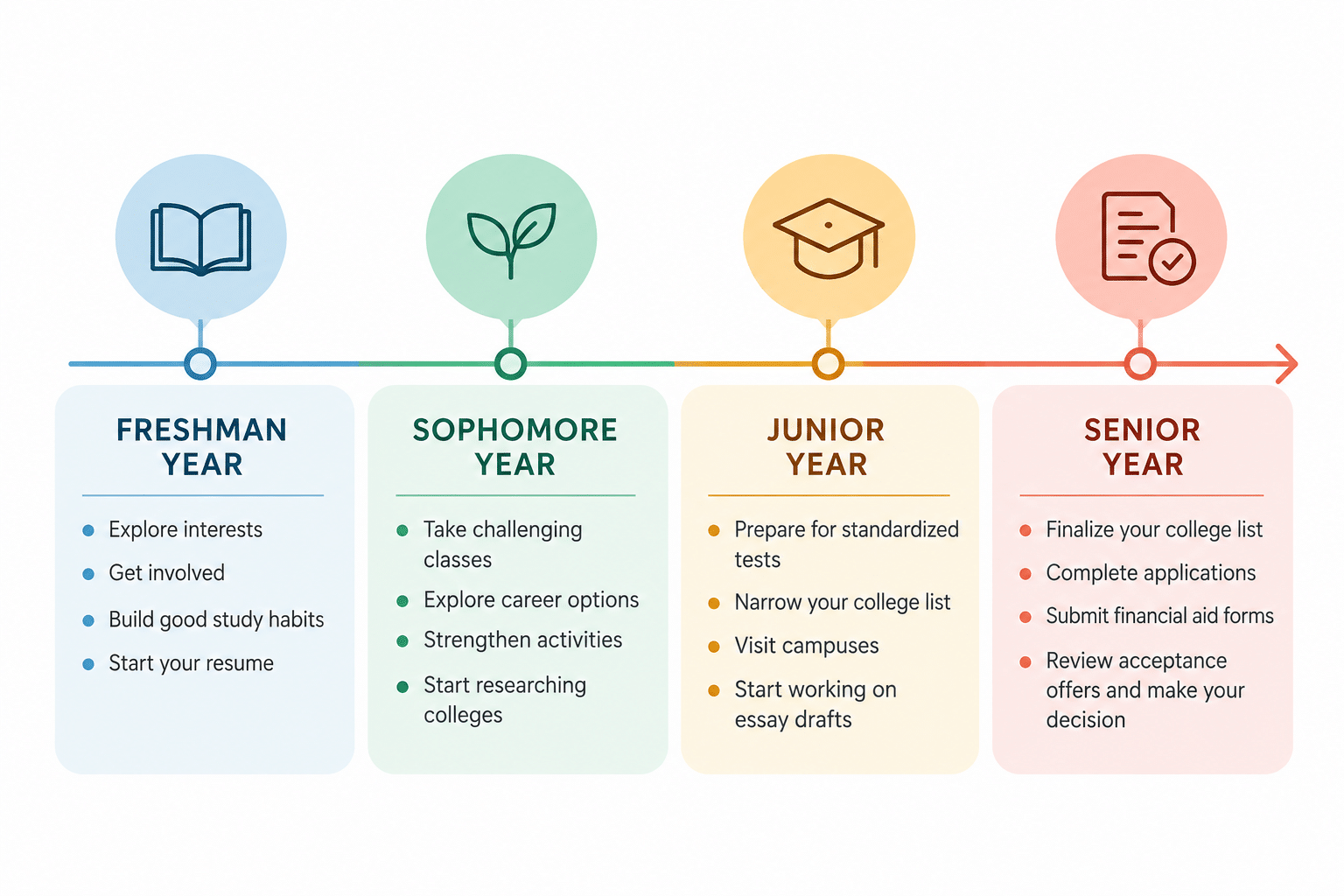
A college admissions roadmap spreads the work across all four years of high school. Freshman year builds strong grades and habits. Sophomore year explores interests and activities. Junior year carries the heaviest load, with rigorous classes, testing, and a first college list. Finally, senior year is for essays, applications, and financial aid. Families who plan early face fewer surprises and make better choices about fit and cost.
College Planning Source builds a personalized college admissions road map for each family. Its programs follow the grade levels: Early College Planning for 9th graders, Prime College Planning for 10th and 11th graders, and Crucial College Planning for seniors. Counselors pair admissions guidance with college funding strategy, and every session runs over Zoom. To get started, families can book a complimentary one-hour virtual assessment or join a free live webinar.
Quick Takeaways
- Every year counts. Colleges see grades from 9th grade onward, and the UC system calculates GPA from 10th- and 11th-grade courses.
- Junior year is the busiest year, with the hardest classes, testing, campus visits, and a first college list.
- The Common App and UC application both open on August 1. That makes the summer before senior year the best time to start essays.
- Testing still matters. Most colleges remain test-optional, but more selective schools now require scores again.
- Financial aid planning should run alongside admissions planning, since the FAFSA opens in the fall of senior year.
When Should You Start a College Admissions Roadmap?

The best time to start a college admissions roadmap is the summer before or the fall of freshman year. Starting early does not mean adding pressure. Instead, it means choosing the right courses from day one and building good study habits. It also gives a student room to explore interests before the big decisions of junior and senior year.
The biggest risk of a late start is a missing course. For example, a student may discover in 11th grade that their math track cannot reach precalculus in time. Similarly, a world language may have stopped after one year. For California students, the A through G course requirements for UC and CSU admission make early planning especially important.
What Should Freshmen Focus On in 9th Grade?
The freshman stage of a college admissions road map has three goals. First, earn solid grades. Second, choose a schedule that is challenging but manageable. Third, try a few activities. Ninth grade grades appear on the transcript every college sees, so a strong start protects a student’s options.
A practical 9th grade checklist looks like this:
- Meet the school counselor and map out a four-year course plan.
- Join two or three clubs, teams, or service activities and see what sticks.
- Keep a running list of activities, awards, volunteer hours, and summer experiences.
- Use summer for something meaningful, such as a job, a camp, volunteering, or a personal project.
What Should Sophomores Do in 10th Grade?
In a college admissions roadmap, sophomore year is about increasing rigor and deepening involvement. Students should take honors or advanced courses when they are ready. They should also narrow their activities to the ones they truly enjoy. Many sophomores take the PSAT 10 or a practice test to get a baseline score.
This is the year when depth starts to beat breadth. For instance, admissions readers notice a student who grew from member to organizer.
Career exploration is also useful now. College Planning Source includes personality, interest, and abilities profiling in its student development program. As a result, students can connect what they enjoy to possible majors before the college list takes shape.
Why Is Junior Year the Most Important Year for College Admissions?

Junior year is the most important stage of the college admissions road map. It is the last full year of grades most colleges see before they decide. It is also usually the most rigorous year. On top of classes, juniors take the PSAT/NMSQT, prepare for the SAT or ACT, visit campuses, build a first college list, and line up teacher recommendations.
Academics
Colleges look closely at the difficulty and trend of 11th grade courses. For UC applicants, 10th and 11th grade grades drive the GPA used in review. That gives this year extra weight for California families.
Testing
The October PSAT/NMSQT in junior year is the qualifying test for National Merit Scholarship recognition. After that, most students take the SAT or ACT in the winter or spring. This timing leaves room for a retake before senior fall.
College List and Campus Visits
By spring, students should have a working list of reach, target, and likely schools. The list should balance academic fit and cost. Spring break and summer work well for campus visits.
The Summer Before Senior Year
Before August 1, students should finish a personal statement draft, confirm recommendations, and organize their activity list. Those who do so enter senior year with far less stress.
What Does the Senior Year College Application Timeline Look Like?
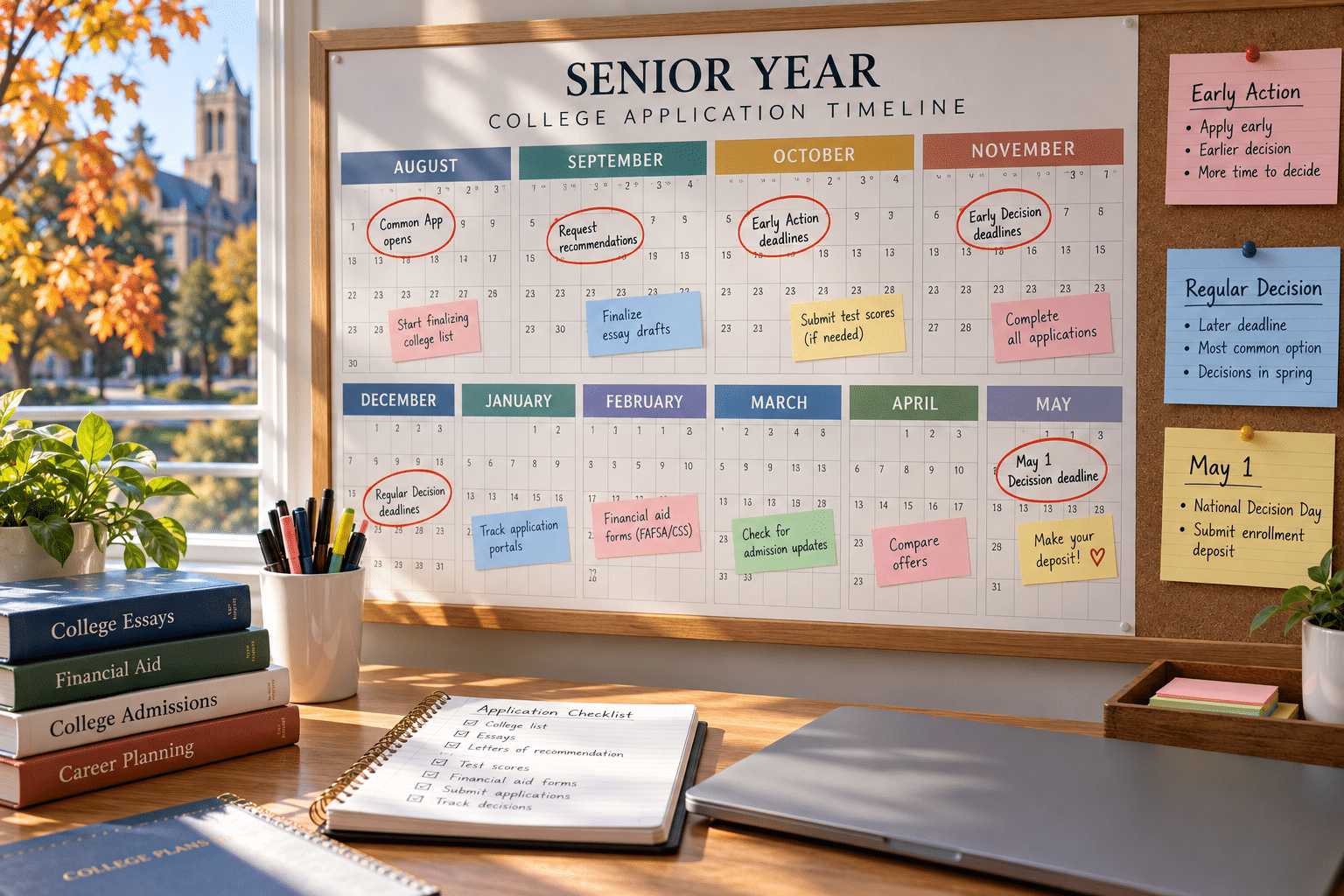
The final year of the college admissions road map follows a predictable calendar. Applications open in August, and early deadlines arrive in November. Regular decision deadlines then fall in January. Finally, students commit to a college by May 1. The table below shows a typical timeline for fall 2027 admission.
| Timing | Key Tasks |
|---|---|
| August 1 | Common App and UC application open; finalize essays and activity list |
| September to October | Request recommendations, submit the FAFSA and CSS Profile where required |
| October 1 to November 30 | UC application filing period for fall 2027 |
| November 1 or 15 | Common Early Action and Early Decision deadlines |
| December | Early decisions arrive; finish regular decision essays |
| January 1 to 15 | Most regular decision deadlines |
| March 2 | California Cal Grant deadline for the FAFSA or CADAA |
| March to April | Admission decisions and financial aid offers arrive |
| May 1 | Common deadline to commit to one college |
Keep in mind that the UC application is separate from the Common App. It has its own four personal insight question essays. So a student who finishes the Common App in October still has UC writing left before November 30. Meanwhile, the Common App essay keeps the same seven prompts as recent years, at 250 to 650 words.
How Do Standardized Tests Fit Into the Roadmap Now?
Standardized tests are optional at most colleges, but more selective schools require them again. According to FairTest, only 161 of 2,247 colleges require scores for the 2026 to 2027 cycle. That is about 7 percent. Roughly 86 percent remain test-optional. However, much of the Ivy League and several other selective schools have brought requirements back.
For most families, a solid college admissions roadmap includes at least one SAT or ACT in junior year. A strong score keeps every door open. The main exception is a student applying only to test-free systems. For example, University of California campuses do not use SAT or ACT scores in admission decisions. They may still use scores for course placement after enrollment.
When Should Families Start Thinking About Financial Aid?
Families should build financial aid into their college admissions roadmap as early as freshman year. Aid formulas use tax information from two years before a student enters college. So the financial picture for a fall 2027 freshman rests largely on 2025 income. That is why waiting until senior year can limit a family’s options.
By law, the FAFSA must open by October 1 each year. In fact, the 2027 to 2028 form opened even earlier, its earliest launch ever. California students should also mark the March 2 Cal Grant deadline.
A financially balanced college list matters just as much as filing on time. College Planning Source’s funding program reviews a family’s full financial picture. It estimates the average net cost for each child’s education. Then it builds a plan that also accounts for retirement and other household goals. The firm’s financial advisors bring more than 15 years of experience in education and family financial planning.
Which Roadmap Mistakes Do Families Make Most Often?
The most common college admissions roadmap mistakes are easy to spot in hindsight. Families start too late, build an unbalanced college list, or treat admissions and financial aid as separate problems. Fortunately, early planning makes each avoidable.
Watch for these common mistakes:
- Waiting until senior year to research colleges or start essays.
- Applying only to reach schools without enough likely and affordable options.
- Joining many activities without showing depth or leadership in any of them.
- Skipping required courses that close off certain majors or the UC and CSU systems.
- Ignoring net price until acceptance letters and aid offers arrive in spring.
Why Choose College Planning Source for Your College Admissions Roadmap?
College Planning Source is a San Diego-based college planning firm. It combines admissions counseling and college funding strategy in one plan. The firm reports working with more than 3,000 families and students. Its approach treats student development and college funding as connected goals that belong in the same plan.
Every student works with an assigned college planning counselor. The counselor helps with course selection, activities, SAT and ACT scheduling, campus visits, career assessment, and a balanced college list. As applications approach, the team adds a custom planning calendar and essay development and review. It also reviews every application before submission.
Right now, the firm is enrolling students in the Classes of 2028, 2029, and 2030. That makes this a strong time for freshmen, sophomores, and juniors to begin.
Frequently Asked Questions

Is it too late to start a college admissions road map in junior year?
No, junior year is still a good time to start, although the plan will be tighter. Students can focus on strong 11th grade grades, testing and a balanced college list. They can then use the summer for early essay work. Because there is less time to adjust courses, families should act quickly and start with the highest impact steps.
How many colleges should a student apply to?
Most students do well applying to about 8 to 12 colleges. The list should balance reach, target, and likely schools. Applying to too few colleges limits options. On the other hand, applying to too many can weaken essay quality and drive up application fees.
What is the difference between Early Action and Early Decision?
Early Action lets students apply early, usually by November 1 or 15. Students then hear back sooner, with no obligation to attend. Early Decision, by contrast, is binding. An admitted student must enroll and withdraw other applications. Early Decision can improve admission odds at some colleges, but it limits a family’s ability to compare aid offers.
Is a private college counselor worth it?
A private college counselor can be worth it for families who want more individual attention. Busy school counseling offices often cannot offer that. A counselor also helps connect admissions strategy with college costs. The value is greatest when counseling starts early enough to shape courses, activities, and the college list.
What happens during a free college planning assessment at College Planning Source?
The complimentary assessment is a one-hour virtual meeting with a college planning specialist. It covers the student’s career and major interests, testing timelines, and activities. It also reviews application timelines and merit scholarships. Finally, it looks at building a balanced college list and stress-tests the family’s current college funding plan.
Ready to Build Your College Admissions Roadmap?
A strong college admissions roadmap turns four years of high school into manageable steps. It runs from the first freshman schedule to the May 1 decision. College Planning Source helps families build that plan with dedicated counselors, essay support, and college funding strategy. Every session takes place over Zoom.
At College Planning Source, we help students and families navigate every step of the college admissions process. Get direct one-on-one guidance with a complimentary virtual college planning assessment—call 858-676-0700 or schedule online at collegeplanningsource.com/assessments.