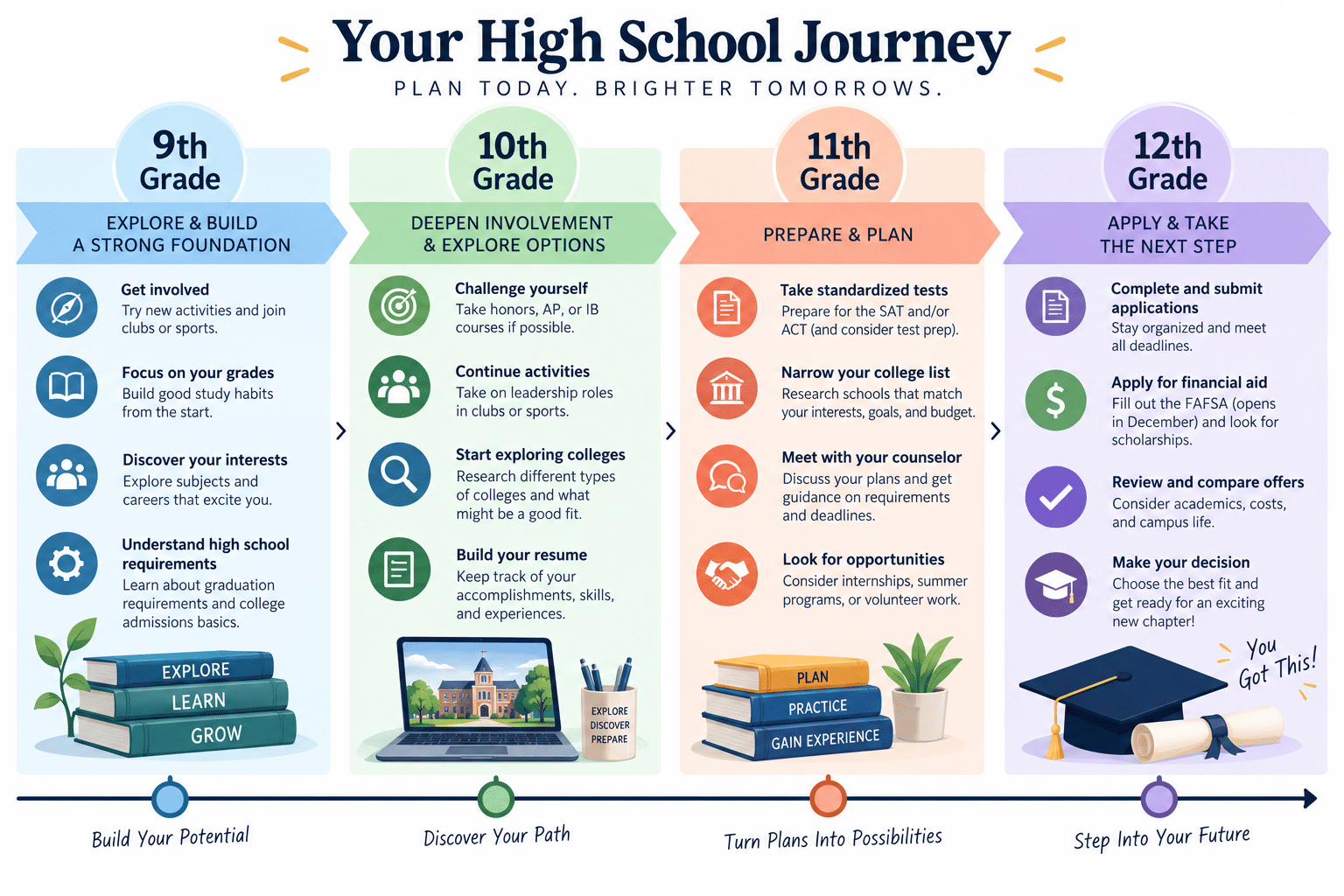
A college admissions strategy is a multi-year plan that aligns a student’s coursework, activities, testing, essays, and college list with what individual schools value—rather than reacting to application deadlines as they arrive. The strongest strategies start well before senior year, since grades and course rigor built up over time carry more weight than anything written in a single application cycle.
How This Relates to College Planning Source
College Planning Source, a San Diego-based college and financial planning firm founded in 2005, builds individualized admissions strategies through its College Bound Program, which covers student profile development, application and essay management, and financial aid planning. Families can currently start with a complimentary one-on-one college planning assessment with a Certified College Planning Counselor.
Quick Takeaways
- Grades in college-prep courses and overall high school grades are consistently the two factors colleges weigh most heavily — well ahead of essays, recommendations, or demonstrated interest.
- A strong admissions strategy typically starts in 9th or 10th grade, not senior fall, since course selection and grade trends build over multiple years.
- Applying Early Decision or Early Action can carry a meaningful acceptance-rate advantage at many schools, though colleges caution that early applicant pools tend to be stronger to begin with.
- A “balanced” college list — reach, target, and likely schools — protects students from ending up with no good options in the spring.
- Financial aid strategy (FAFSA, CSS Profile, net price calculators) works best when it’s planned alongside, not after, the admissions strategy.
- College Planning Source offers a complimentary one-on-one assessment as a starting point for families building their plan.
What Is a College Admissions Strategy?

A college admissions strategy is a coordinated plan covering four areas — academics, activities, testing, and applications — built around the specific colleges a student is targeting, rather than a generic checklist applied the same way to every school. It’s the difference between reacting to each requirement as it comes up and working backward from where a student wants to end up.
Because different colleges weigh factors differently — some remain test-optional, some prioritize demonstrated interest, some care heavily about intended major — a real strategy requires knowing the target schools’ actual admission patterns, not just general advice. Families without a plan often make decisions (dropping a difficult class, skipping an activity, rushing an essay) without realizing how those choices interact with a specific school’s priorities.
When Should You Start Building Your College Admissions Strategy?
Most counselors recommend starting a college admissions strategy in 9th or 10th grade, since course selection, grade trends, and extracurricular depth compound over four years and can’t be manufactured in a single senior-year push. Starting early doesn’t mean rushing decisions — it means giving the plan room to adjust.
An early start allows a family to see how a student’s grades and interests develop before locking into a narrow list of target schools, and it gives time to address weak spots — a difficult subject, a thin activity list, an undecided testing plan — well before applications are due. Starting in junior or senior year isn’t fatal, but it compresses decisions that ideally unfold over time, particularly around building a meaningful, sustained extracurricular record rather than a last-minute list of activities.
What Do Colleges Actually Look For in Applicants?
Colleges consistently rank grades in college-prep courses and overall high school grades as the most important admission factors, with curriculum strength next, while essays, recommendations, and demonstrated interest carry comparatively less weight. This holds true across NACAC’s annual survey of member colleges going back over a decade.
According to NACAC’s Fall 2023 survey of member four-year colleges, 76.8% rated grades in college-prep courses as being of “considerable importance,” followed closely by overall high school grades and strength of curriculum, while positive character attributes, essays, and demonstrated interest ranked meaningfully lower. The survey also notes that test-score importance has declined substantially since 2020 alongside the wider adoption of test-optional admissions policies.
| Factor | Share of Colleges Rating It “Considerable Importance” (Fall 2023) |
|---|---|
| Grades in college-prep courses | 76.8% |
| Overall high school grades | 74.1% |
| Strength of high school curriculum | 63.8% |
| Positive character attributes | 28.3% |
| Essay or writing sample | 18.9% |
| Demonstrated interest | 15.7% |
| Counselor recommendation | 11.9% |
How Do You Build a Balanced College List?
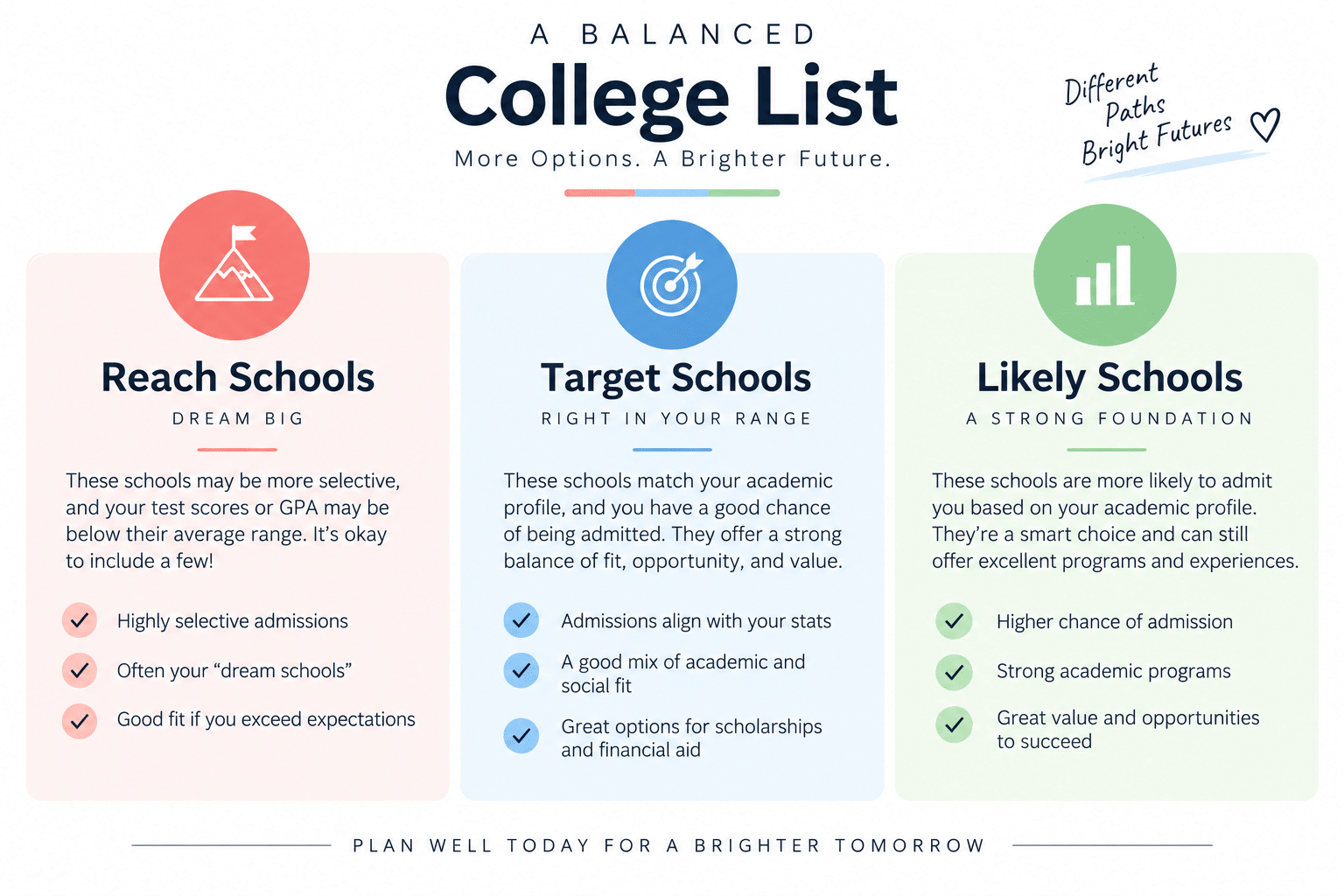
A balanced college list includes reach schools (where admission is a stretch), target schools (where a student’s profile fits the typical admitted range), and likely schools (where admission is highly probable) so that every applicant ends the process with real options. Building the list around fit — academic, financial, and personal — matters as much as prestige.
A common mistake is building a list that’s almost entirely reach schools, which leaves a student without a genuinely good option if none of those admit them. A well-built list also accounts for cost from the start, since a “likely” school that’s financially out of reach isn’t actually a safe option. Families should run each school’s net price calculator before finalizing a list, not after submitting applications.
How Important Are Essays and Extracurriculars in an Admissions Strategy?
Essays and extracurriculars matter, but they typically rank below academic factors in colleges’ own stated priorities — their real value is in showing colleges a coherent, specific picture of a student rather than compensating for weak grades. A strong essay and activity list rarely overcome a thin academic record, but a strong academic record paired with a generic essay and scattered activities also underperforms.
Colleges consistently describe wanting depth over breadth in activities — sustained involvement and real responsibility in a few things tends to read better than a long list of shallow memberships. Essays work best when they’re specific to the student’s actual experience rather than written to sound impressive, since admissions readers evaluate large volumes of essays and notice generic writing quickly.
Should You Apply Early Decision or Early Action?
Applying Early Decision or Early Action can carry a real acceptance-rate advantage at many colleges, but the advantage is partly explained by a stronger, more prepared applicant pool rather than the early round itself lowering the bar. Whether it makes sense depends on whether a student has a clear first-choice school and, for binding Early Decision specifically, whether the family can commit without comparing financial aid offers.
Historical analysis by U.S. News & World Report found that the typical early acceptance rate ran about 15 percentage points higher than the regular decision rate at colleges reporting separate figures, at more than 80% of the schools studied. Colleges themselves caution that early applicant pools tend to include unusually well-prepared, highly committed students, which inflates the apparent advantage of the round itself. Because Early Decision is binding, families should compare estimated financial aid packages using net price calculators before committing, since backing out of an ED acceptance for financial reasons is only possible if the aid offer doesn’t meet demonstrated need.
How Does Financial Aid Fit Into a College Admissions Strategy?

Financial aid planning works best alongside admissions strategy, not after acceptance letters arrive, since a student’s college list should already reflect what a family can realistically afford. Waiting until spring of senior year to think about cost often means discovering a “dream school” acceptance isn’t financially workable.
FAFSA and CSS Profile
Most financial aid—federal, state, and institutional—starts with the FAFSA, and many private colleges also require the CSS Profile for institutional aid; file both as early as each opens, since some aid is awarded on a rolling basis.
Merit vs. Need-Based Aid
Merit aid is awarded based on a student’s academic profile independent of financial need, while need-based aid depends on a family’s calculated ability to pay; a student’s list should ideally include some schools likely to offer strong merit aid as a financial cushion.
Expected Family Contribution
Every school calculates an estimate of what a family can contribute, and that figure can vary meaningfully between schools even for the same family — which is why running each school’s own net price calculator matters more than relying on a single national estimate.
College Planning Source’s services include financial aid guidance covering FAFSA submission, CSS Profile registration, cost-of-attendance analysis, and financial aid negotiation support as part of its broader College Bound Program.
Is Working With a College Admissions Counselor Worth It?
Working with a college admissions counselor is most valuable for families who want a structured, multi-year plan rather than piecemeal advice, or who are navigating financial aid and essay strategy for the first time without a clear roadmap. It’s less essential for families who already have strong college-planning knowledge and simply need occasional guidance.
| Situation | Recommendation |
|---|---|
| Starting in 9th or 10th grade with no clear plan | Full multi-year counseling program |
| Senior year, applications already underway | Focused essay and application support |
| Confident on academics, unsure about financial aid | Financial aid and funding-focused sessions |
| Just want a gut check before finalizing a list | A one-time assessment or consultation |
Why Choose College Planning Source for Your College Admissions Strategy?
College Planning Source has worked with San Diego-area families on college admissions and financial planning since 2005, offering a structured College Bound Program that covers student profile development, application and essay management, and financial aid and funding strategy under one plan. The firm’s counselors hold Certified College Planning Counselor credentials and work with families through virtual counseling sessions, admissions planning webinars, and campus visit guidance.
Families can start with a complimentary one-on-one assessment, during which a counselor reviews a student’s current academic and extracurricular profile and outlines next steps. The firm is based at 10875 Rancho Bernardo Road, Suite 115, San Diego, CA 92127, and can be reached at 858.676.0700.
Frequently Asked Questions

How early should we start working on a college admissions strategy?
Most counselors recommend starting in 9th or 10th grade, since course selection and grade trends compound over four years and are difficult to correct in a single senior-year effort. Starting later is still workable, but it narrows the window for building a strong academic and extracurricular record.
Do standardized test scores still matter if a college is test-optional?
Test scores still matter at many test-optional schools, but their overall importance has declined industry-wide since 2020 as more colleges adopted test-optional policies. Whether to submit scores usually depends on how a student’s scores compare to the school’s typical admitted range.
How many colleges should a student apply to?
There’s no universal number, but a balanced list generally includes a mix of reach, target, and likely schools rather than a heavy skew toward only the most selective options. The right number depends on how much research and application time a student can realistically put into each school.
Is Early Decision a good idea if we need financial aid?
Early Decision is binding, so families relying on financial aid should run net price calculators for target schools before applying ED, since you can’t compare offers across schools once you accept a binding commitment. Early Action, which isn’t binding, is often a safer choice for families who need to compare aid packages.
What’s the difference between a college counselor and a high school guidance counselor?
High school guidance counselors typically manage a large caseload covering academics, scheduling, and general student support, while independent college counselors focus specifically on admissions strategy, essays, and financial aid for a smaller number of families. Many families use both, since each serves a different role in the process.
Ready to Build Your College Admissions Strategy?
A college admissions strategy works best when it’s built early, tailored to specific target schools, and coordinated with a realistic financial aid plan — not assembled last-minute during senior fall. College Planning Source works with families throughout the college admissions and financial aid process, from initial profile development through application submission and funding strategy. Families can start with a complimentary one-on-one assessment to see where their student’s current plan stands and what to prioritize next.
At College Planning Source, we help students and families navigate every step of the college admissions process. Get direct one-on-one guidance with a complimentary virtual college planning assessment—call 858-676-0700 or schedule online at collegeplanningsource.com/assessments.