College timeline planning means mapping every high school semester to specific admissions and financial aid tasks so nothing piles up in the fall of senior year. Students build their transcript and activities in ninth and tenth grade, test and research colleges in eleventh grade, draft essays the summer before senior year, then submit applications and aid forms between August and March. Setting personal due dates ahead of every official deadline keeps the whole plan on track.
College Planning Source, a San Diego college planning firm founded in 2005, builds a personalized college planning timeline and admissions applications calendar for each student, along with application tracking and FAFSA and CSS Profile support. Families can start with a complimentary one hour virtual college planning assessment that reviews testing timelines, application deadlines and the family’s college funding plan. The firm is currently enrolling students in the Classes of 2028, 2029 and 2030.
Quick Takeaways
- Good college timeline planning works backward from every deadline, with personal due dates two to three weeks earlier than the official ones.
- Ninth and tenth grade build the transcript, eleventh grade is the heaviest testing and research year, and senior fall is for submitting.
- The summer before senior year is the best window to draft essays and finalize a balanced college list.
- For fall 2027 entry, University of California applications are due November 30, 2026, and the California Cal Grant deadline is March 2, 2027.
- Financial aid runs on its own clock. The 2027-28 FAFSA opened in late September 2026 and the CSS Profile opened October 1, 2026.
- College Planning Source offers a free virtual assessment for families who want a customized semester by semester plan.
What Is College Timeline Planning?
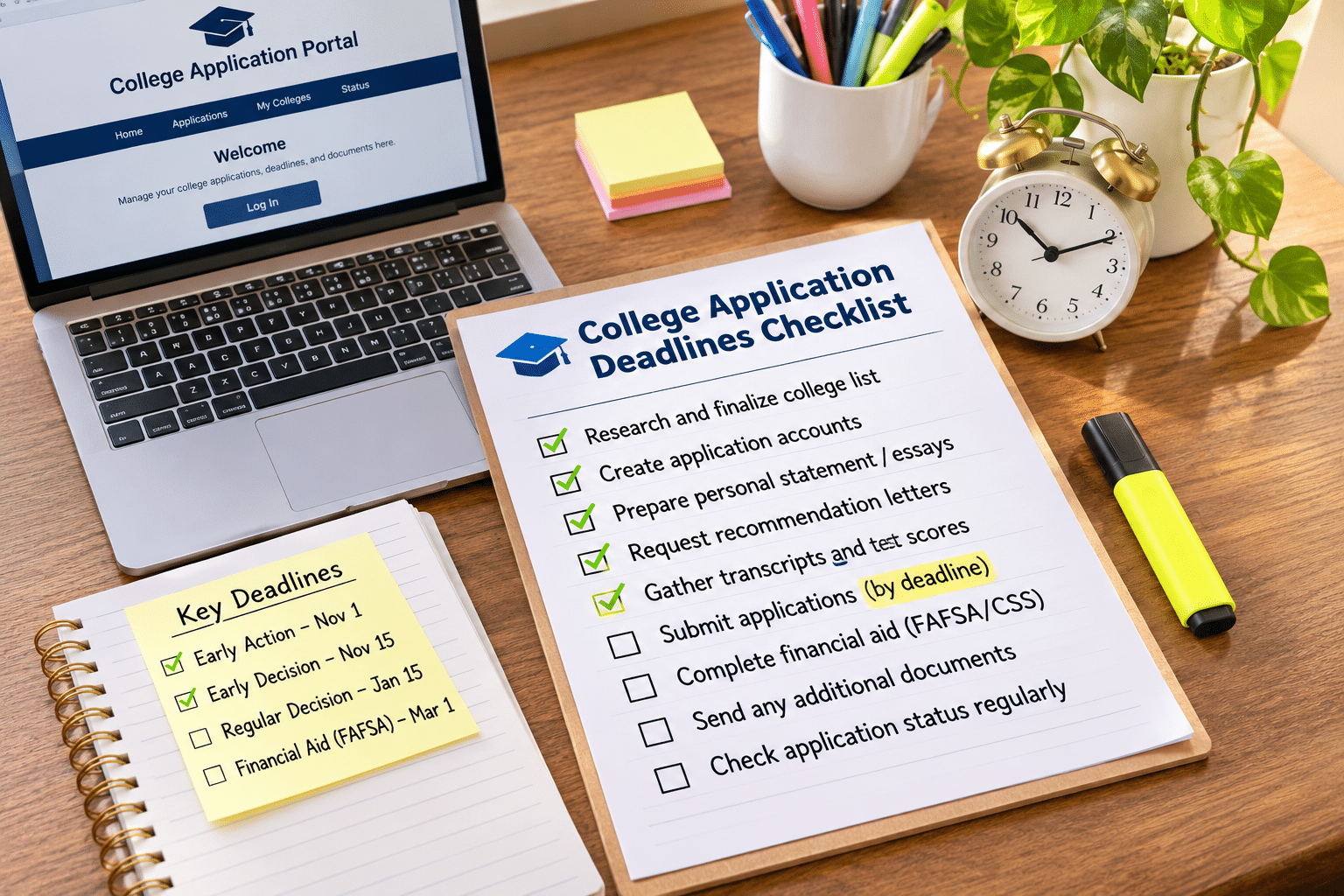
College timeline planning turns the four years of high school into a calendar of concrete tasks tied to admissions and financial aid deadlines. Instead of reacting to due dates as they appear, families decide in advance when the student will take each test, visit campuses, write essays and file aid forms, so every requirement is finished early.
A good timeline covers three tracks that run side by side. The academic track includes course selection, grades and meeting requirements such as California’s A-G sequence for UC and CSU. The admissions track covers testing, activities, the college list, essays and applications. The financial track covers savings, aid estimates, the FAFSA, the CSS Profile and scholarships.
Most missed deadlines happen because students ignore one track until senior year. A written timeline keeps all three visible at once.
When Should You Start Planning a College Timeline?
The ideal time to start college timeline planning is the summer before or the fall of ninth grade, because colleges review every grade from freshman year onward. Starting in tenth or eleventh grade still works, but the plan becomes more compressed and leaves less room to strengthen grades, course rigor and activities.
Planning your college timeline early doesn’t mean pressure from day one. A freshman timeline is light: choose a challenging but manageable schedule, try a few activities and learn the basic requirements. The workload grows each year, and an early start simply spreads it out.
Families who begin in junior year can still succeed. The focus shifts to testing, a realistic college list and getting a head start on essays before summer ends.
What Should Students Do Each Semester of High School?
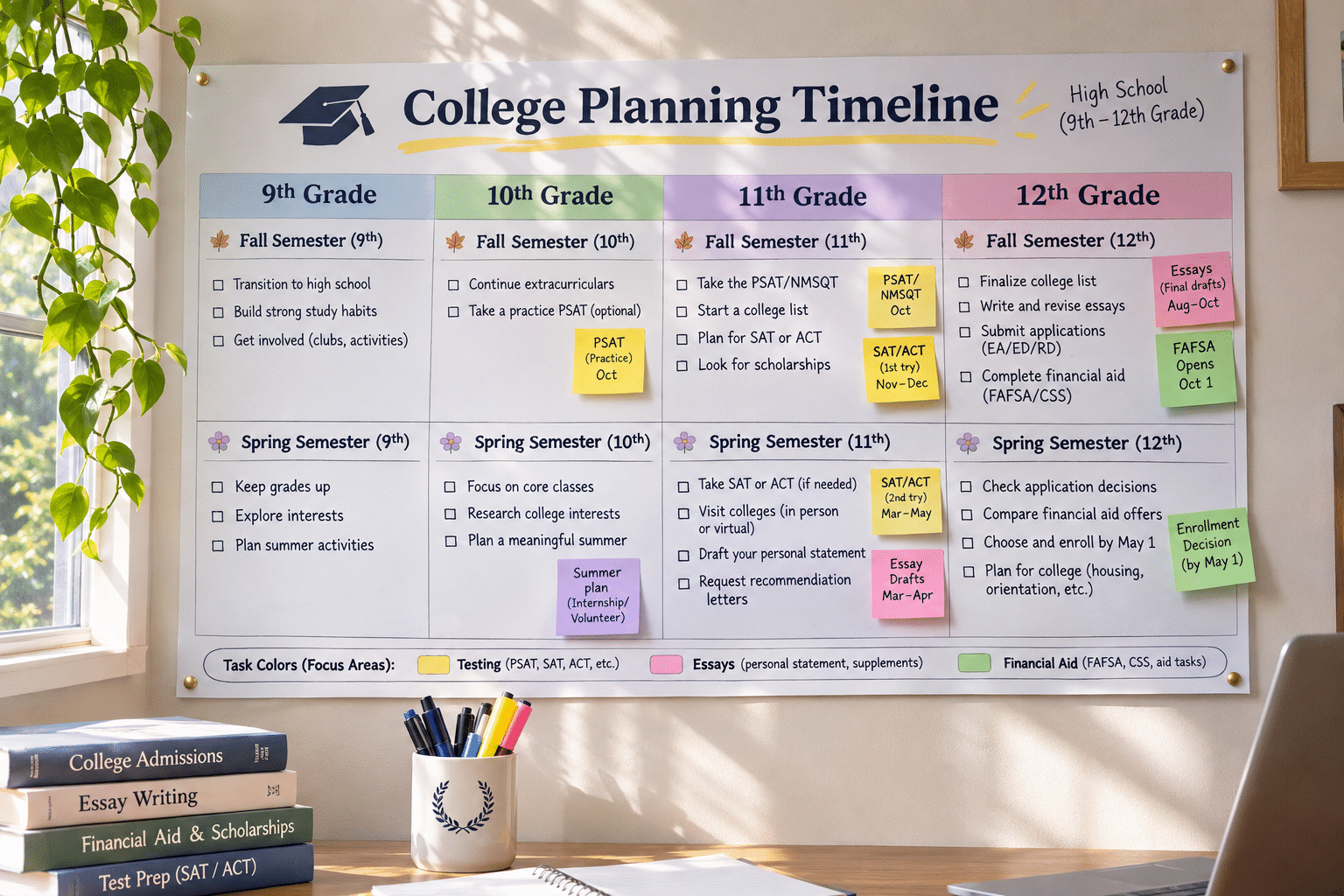
In college timeline planning, each semester of high school has a clear job. Freshman and sophomore semesters build academics and interests, junior semesters focus on testing and research, and senior semesters focus on applications, financial aid and the final decision. The table below maps the core tasks to each term.
| Semester | Core Tasks |
|---|---|
| 9th grade fall | Choose a rigorous course plan, track A-G requirements, join one or two activities |
| 9th grade spring | Review grades, plan sophomore courses, find a meaningful summer activity |
| 10th grade fall | Take the PSAT for practice if offered, deepen activities, start a resume |
| 10th grade spring | Explore majors and careers, plan junior year rigor, consider summer programs |
| 11th grade fall | Take the PSAT/NMSQT, which counts toward National Merit, and build a testing plan |
| 11th grade spring | Take the SAT or ACT if needed, visit campuses, draft a college list, request teacher recommendations |
| Summer before 12th | Draft essays and UC Personal Insight Questions, finalize the list, create a Common App account |
| 12th grade fall | Submit early and priority applications, file the FAFSA and CSS Profile, send scores if required |
| 12th grade spring | Report midyear grades, compare aid offers, appeal if needed, commit by May 1 |
Summers matter as much as semesters. Colleges notice how students use their time, and the summer before senior year is when most strong essays are written.
Testing deserves a deliberate decision in any college timeline planning, not a default. The UC and CSU systems do not consider SAT or ACT scores for admission, so a California student applying mainly to public universities may put that time into grades, activities and the Personal Insight Questions instead. Students applying to private or out of state colleges that use scores usually plan a first SAT or ACT in junior spring, leaving the summer and early senior fall open for a retake.
What Are the Key College Application Deadlines for Fall 2027?
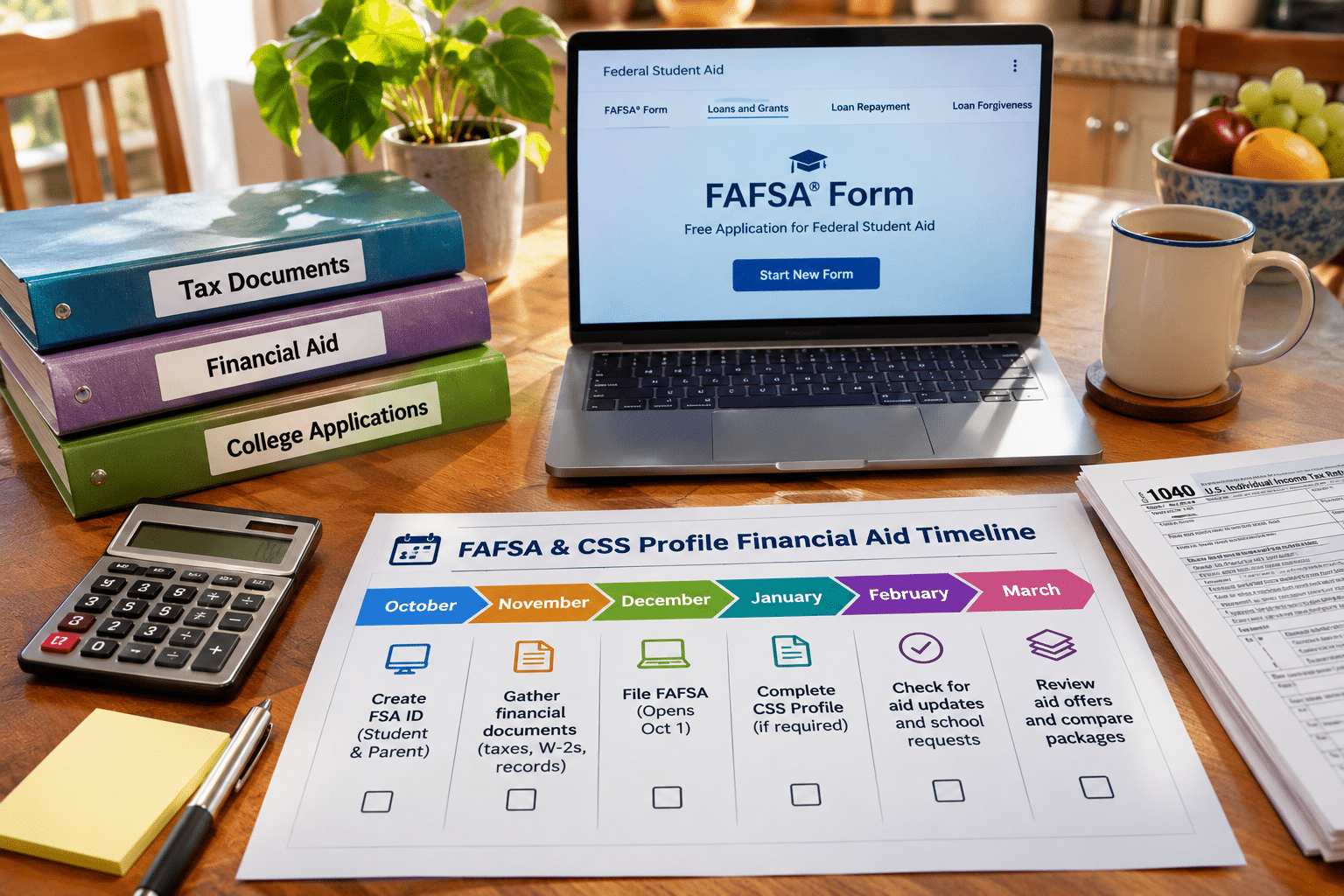
For students entering college in fall 2027, college timeline planning centers on dates between August 2026 and May 2027. The UC application opened August 1, 2026, with a submission window of October 1 to November 30, 2026. Many private colleges set early deadlines on November 1 or 15, and regular decision deadlines often fall in early January.
| Date | Deadline or Milestone |
|---|---|
| August 1, 2026 | UC application opens for fall 2027 applicants |
| Late September 2026 | 2027-28 FAFSA opens, the earliest launch in the program’s history |
| October 1, 2026 | UC and CSU submission windows open, CSS Profile opens |
| November 1 or 15, 2026 | Common early decision and early action deadlines at many private colleges |
| November 30, 2026 | UC application deadline and CSU priority filing deadline |
| Early January 2027 | Regular decision deadlines at many private colleges |
| March 2, 2027 | California Cal Grant deadline for the FAFSA or California Dream Act Application |
| March 2027 | UC campuses generally release fall 2027 decisions |
| May 1, 2027 | Statement of Intent to Register deadline at UC and common national commitment date |
Always confirm dates on each college’s own admissions page before locking in your college timeline planning, because individual schools set their own early, regular and financial aid deadlines. UC has extended its deadline in some past years, including moving it to December 1 for the fall 2026 cycle, but students should treat November 30 as the final deadline.
How Does the Financial Aid Timeline Fit In?
The financial aid timeline runs alongside the admissions timeline, so college timeline planning should cover both together rather than one after the other. Families should estimate costs during junior year, gather tax documents over the summer, then file the FAFSA and CSS Profile in the fall of senior year, often before the earliest application deadlines.
Colleges that use the CSS Profile frequently require it by early to mid November for early decision applicants, so aid paperwork can come due at the same time as the application itself. California residents also need to file the FAFSA or the California Dream Act Application by March 2 to be considered for a Cal Grant, along with a verified GPA submitted by their high school.
The CSS Profile costs $25 for the first school and $16 for each additional school, with fee waivers available for many families. Building these costs and dates into your college timeline planning prevents last minute surprises.
How Do You Build a College Timeline That Actually Keeps You on Track?
The most reliable way to build a college timeline is to plan backward. Start with each final deadline, subtract time for review and unexpected delays, and set an internal due date two to three weeks earlier. Then break each large task, such as an essay or the FAFSA, into weekly steps on a shared calendar.
- List every school and its deadlines. Record application, financial aid, scholarship and housing dates in one place.
- Set internal deadlines. Finish drafts early enough to allow review from a teacher, counselor or parent.
- Assign owners. Students own essays and applications, while parents usually own tax documents and aid forms.
- Schedule weekly check-ins. A fifteen minute review each Sunday catches problems while they are still small.
- Build in buffer time. Websites crash near deadlines and recommenders get busy, so submit several days early.
A shared digital calendar with reminders is the simplest college timeline planning tool for most families. The key is that everyone can see the same plan.
What Are the Most Common College Timeline Mistakes?

The most common college timeline mistakes are starting essays too late, leaving financial aid until after applications are submitted, and relying on memory instead of a written calendar. Each one turns a manageable process into a stressful rush during the busiest months of senior year.
Other frequent mistakes include asking for recommendation letters in the fall instead of the spring of junior year, missing early decision CSS Profile deadlines, building a college list without checking likely cost, and forgetting to submit midyear grade reports. Students also sometimes overlook that each college can set its own priority deadlines for scholarships and honors programs, which may come earlier than the general application deadline.
Falling behind is fixable if the student acts quickly and treats college timeline planning as a reset, not a failure. Rank the remaining tasks by deadline, cut the college list to schools the student is genuinely excited about, and reuse strong essay material across prompts where it truly fits. A short, honest conversation with the school counselor or an independent counselor can also reset the plan in a single meeting.
Which College Planning Approach Is Right for Your Family?
The right approach to college timeline planning depends on the student’s independence, the family’s experience with admissions and how much support the high school provides. Self-directed students with strong school counseling may only need a solid calendar, while families facing selective schools, cost concerns or a first college application often benefit from personalized guidance.
| Situation | Recommendation |
|---|---|
| Organized student with strong school counseling | A self-built calendar and periodic check-ins may be enough |
| First student in the family to apply to college | Personalized guidance explains each step before it arrives |
| Student targeting highly selective schools | A long-range plan starting by tenth grade adds the most value |
| Family concerned about college costs | Combine admissions and funding planning from the start |
| Junior starting late | Prioritize testing, the college list and summer essay drafting |
Why Choose College Planning Source for College Timeline Planning?
College Planning Source includes college timeline planning as a core part of its student development services, along with an admissions applications calendar, college application tracking and scheduled guidance check-ins. Its approach ties admissions, financial aid and college funding into one plan, so academic and financial deadlines are managed together rather than separately.
Founder Michelle Mai started the firm after working in the financial aid office at UC Santa Barbara, an experience that shaped its focus on helping families understand the aid system. Today the team supports students with career and major assessments, a balanced college list, essay topic development and editing, final application audits and post-application follow-up.
On the financial side, College Planning Source helps families with cost of attendance outlines, merit and need-based aid estimates, FAFSA submission, CSS Profile registration and submission, a private scholarship database and financial aid negotiation letters. The firm is based on Rancho Bernardo Road in San Diego, offers virtual counseling sessions and hosts free live webinars on admissions and financial aid.
Frequently Asked Questions

How early should a student start college timeline planning?
A student should ideally start college timeline planning in ninth grade, since freshman grades appear on the transcript and course choices affect eligibility for UC, CSU and selective private colleges. Early planning stays light and spreads tasks across four years. Students who start in tenth or eleventh grade can still build a strong plan, but with less flexibility.
What is the most important year in the college timeline?
Junior year is usually the most important year in the college timeline. It carries heavy course rigor, the PSAT/NMSQT that counts toward National Merit, SAT or ACT testing for schools that use scores, campus visits and recommendation requests. Grades from junior year are also the most recent full year colleges see when students apply in the fall.
Should seniors submit college applications early?
Yes. Strong college timeline planning has seniors submit applications early whenever possible. Submitting a week or more before the deadline avoids website slowdowns and leaves time to fix errors. For schools with early action or early decision options, applying early can also mean receiving a decision months sooner, though early decision is binding and requires careful cost planning first.
When should families file the FAFSA for fall 2027?
Families should file the 2027-28 FAFSA as soon as possible after it opens, ideally in October 2026. The form launched in late September 2026, its earliest start ever. Adding the FAFSA to your college timeline early helps families meet college priority dates and California’s March 2, 2027 Cal Grant deadline, since some aid is limited and awarded to early filers.
Is a college planning counselor worth it for timeline planning?
A college planning counselor is often worth it for families who want structure, accountability or help coordinating admissions and financial aid. School counselors frequently manage large caseloads, so independent guidance can add consistent check-ins and personalized college timeline planning. Families with very organized students and strong school support may find a self-built calendar sufficient.
What happens during a free college planning assessment?
At College Planning Source, the free assessment is a one hour virtual meeting with a college planning specialist. Depending on the student’s grade, it can cover career interests, testing timelines, activities, college timeline planning for high school and application deadlines, merit scholarships, a balanced college list and a review of the family’s college funding plan.
Map Out Every Semester With College Planning Source
College timeline planning turns a stressful senior year into a series of manageable steps spread across all four years of high school. When every semester has a clear purpose and every deadline has a buffer, students can focus on doing their best work instead of racing the calendar.
College Planning Source has helped San Diego and Southern California families plan for admissions and college funding since 2005. Schedule a complimentary one hour virtual college planning assessment to review where your student stands, map the semesters ahead and connect application deadlines with your financial aid plan.
At College Planning Source, we help students and families navigate every step of the college admissions process. Get direct one-on-one guidance with a complimentary virtual college planning assessment—call 858-676-0700 or schedule online at collegeplanningsource.com/assessments.