
What Accepted, Waitlisted, and Denied Students Should Do Next
From the College Planning Source Team | H.S. Class of 2026
UC admissions decisions are in — and no matter what your portal says, we want to start with this: you have options, you have support, and we are with you every step of the way.
This guide walks through exactly what to do based on where you landed. Scroll to your section below.
CONGRATULATIONS — YOU’VE BEEN ACCEPTED!
Being admitted to a UC is a real achievement — especially in one of the most competitive application cycles in recent memory. Take a moment to celebrate before diving into the next steps.
What To Do Right Now
- Log in to your UC application portal and confirm your admission status.
- Review your financial aid package and take note of any deadlines.
- Compare offers if you were admitted to multiple UCs or schools.
- Mark May 1 on your calendar — this is the National Candidate Reply Date (NCRD), the deadline to accept your offer for most schools.
Schedule Your Freshman Admit Day (Yield Events)
Every UC campus hosts Freshman Admit Day (or Admitted Student Day) events in the spring. These events are designed to help you experience campus culture, meet current students, and connect with your future classmates. We strongly encourage you to visit any school you are seriously considering.
UC Campus Admit Day Events — Spring 2025 Check each campus portal for exact dates, as they are announced on a rolling basis:
Pro Tip: If you cannot attend in person, most campuses also offer virtual admitted-student events. Ask your counselor for help finding the right links. |
Questions to Ask on Your Visit
- What does a typical day look like in my intended major?
- What housing options are available for freshmen, and when do I choose?
- What clubs, research opportunities, or internships are available in my field?
- How does financial aid work here? Are there additional scholarship opportunities?
- What is the transfer or change-of-major process if I want to adjust my path?
Before May 1: What to Consider
- Financial Aid: Compare net costs across all your acceptances, not just sticker prices.
- Academic Fit: Does this campus offer strong programs in your intended area?
- Campus Feel: What did you notice on your visit or virtual event?
- Geographic Preference: Proximity to home, climate, and environment all matter.
- Gut Feeling: After all the data, what feels right?
✅ Action Checklist for Admitted Students
|
⏳ YOU’VE BEEN WAITLISTED — HERE’S WHAT TO DO
Being placed on a waitlist is genuinely hard — it is not a yes, but it is not a no either. It means the admissions committee found you competitive and wants to keep the door open. Here is how to make the most of this position.
Understanding the UC Waitlist
The UC waitlist operates differently from those at many other schools. Numbers vary significantly by campus, and admission from the waitlist depends on how many enrolled students ultimately choose not to attend (a process called “yield,” which plays out between March and June).
UC Waitlist Data — Class of 2025 (Reference)
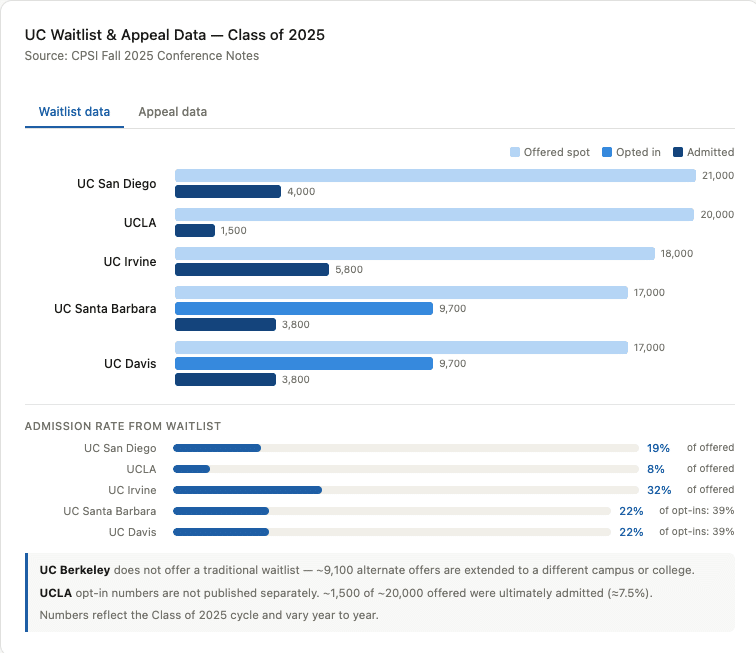
Campus | Waitlisted | Opted In | Admitted from WL |
|---|---|---|---|
UCLA | ~20,000 | — | ~1,500 |
UC Berkeley* | ~9,100 (Alt Offers) | — | Varies |
UC San Diego | ~21,000 | — | ~4,000 |
UC Santa Barbara | ~17,000 | ~9,700 | ~3,800 |
UC Irvine | ~18,000 | — | ~5,800 |
UC Davis | ~17,000 | ~9,700 | ~3,800 |
*UC Berkeley does not offer a traditional waitlist. Instead, they extend Alternate Offers — typically to a different campus or college within the UC system.
As you can see, thousands of students are admitted from waitlists each year — but the process is highly variable and unpredictable. Admission from the waitlist depends on available space and how many admitted students choose to enroll elsewhere.
Step 1: Opt In Right Away
If you receive a waitlist offer at any UC, opt in as soon as possible. Most campuses have a deadline to respond, and waiting can cost you your spot. Look for the opt-in link in your UC application portal — it only takes a few minutes.
Step 2: For UCLA — Submit Your Waitlist Statement
From UCLA Admissions: “Be patient and accept an offer that you currently have available. We cannot predict how many students may receive admission from the waitlist, and for this reason, we do not rank the waitlist. The number of offers we extend depends on available space and how many admitted students we expect to enroll.” |
If you receive a UCLA waitlist offer, you will have the opportunity to submit a waitlist statement. This is your chance to share updates since you applied — new grades, achievements, a recent experience, or simply a renewed expression of your interest in UCLA. We have a full guide with an outline and a sample statement to help you get started. Ask your counselor for the UCLA Waitlist Statement Guide.
What to Include in Your Waitlist Statement
- New academic achievements or grade improvements since you submitted your application
- New honors, awards, or recognitions earned since applying
- A meaningful recent experience that has shaped you
- A specific reason why UCLA remains your top choice — be genuine, not generic
- Keep it concise: aim for 250–350 words, focused and authentic
Step 3: Stay on Top of Your Email
Waitlist decisions run from April through June. Starting May 1, check your email every single day. Waitlist offers often come with short response windows — sometimes 48–72 hours. Make sure your spam filter is not burying important messages from UC domains.
Step 4: Secure Your Backup Plan — Before May 1
⚠️ This is critical: You must submit your SIR (Statement of Intent to Register) at another school by May 1. Being on a waitlist does not hold your place anywhere. Accept the best offer you currently have in hand — you can always choose to attend the waitlisted school if you are admitted later. |
What Else Should You Do in the Meantime?
- Visit your accepted school(s) and attend their admitted student events — you may fall in love with your current option.
- Research your backup school thoroughly — housing, academics, community, and campus life.
- Stay academically strong through the end of the year — your senior transcript matters.
- Communicate with your counselor regularly — we will update you as soon as we hear anything.
💙 IF YOU WERE DENIED — YOU ARE NOT ALONE, AND YOU HAVE A PATH FORWARD
A denial from a UC — especially one you had your heart set on — stings. That is completely valid. Let yourself feel it. And then, when you are ready, let us talk about what is next, because there is a very real path forward.
Understand What This Means (and What It Doesn’t)
- A denial is not a reflection of your worth, your intelligence, or your future.
- UC admissions at the most selective campuses are highly competitive — many qualified students are denied admission.
- This was one of the most competitive UC application cycles in recent history. Admission rates were lower across the board.
- Students who are denied from their dream schools go on to thrive at other institutions every year.
Your Options After a Denial
Option 1: Accept Another Offer You Have
If you were admitted to other UCs, Cal States, private schools, or out-of-state universities, you may have excellent options already waiting. Revisit those offers with fresh eyes. Attend their admitted student events. You might be surprised.
Option 2: Consider Community College + Transfer
California’s Transfer Admission Guarantee (TAG) program allows students who attend select California community colleges to receive guaranteed admission to a UC campus (UC Santa Cruz, UC Merced, UC Riverside, UC Santa Barbara, UC Davis, and UC Irvine participate — UCLA and Berkeley do not offer TAG). For students who want to ultimately attend a specific UC, this is a legitimate and well-traveled path.
Transfer Pathway Highlights:
|
Option 3: Attend Another School and Reapply
If attending a UC is truly important to you, it is possible to enroll at another school for a year and reapply as a freshman — though this path requires careful planning. Talk to your counselor before pursuing this option.
Option 4: Make the Most of Where You Land
Many students find that the school they initially settled for becomes the place they cannot imagine having gone anywhere else. Internships, research, community, and growth happen at every institution. What you bring to your college experience matters as much as where you go.
📝 IF YOU ARE CONSIDERING AN APPEAL
An appeal is not a second application. It is a very specific type of letter, and most students write the wrong one. Before deciding whether to appeal, students and families need to understand if an appeal is worth filing.
UC Appeal Data — Fall 2025 Conference – This is NOT guaranteed every year
Campus | Appeals filed | Admitted |
UC Santa Barbara | 900 | 60 (6.7%) |
UC Irvine | 1,600 | 16 (<1%) |
UCLA | 1,924 | 2 (0.1%) |
UC Davis | 695 | 4 (0.6%) |
UC Berkeley, UCSD, UCSC, UCR, UCM | — | — |
Source: CPSI Fall 2025 Conference Notes. The data reflect the Class of 2029 application cycle.
What Makes a Strong Appeal Letter
Most appeal letters fail for the same reasons: they are too general, too emotional, and too focused on how much the student wants in — rather than what the student brings and why that specific campus is the right fit. Here is what separates the letters that work from the ones that do not.
- It must include new information
The single most important element of a strong appeal is new information that was not in the original application — achievements, awards, competition results, or leadership roles completed after November. If a student is simply restating what was already in their file, or only updating grades, the appeal will not work. Admissions officers have already read the application. New information signals growth and continued momentum, which is exactly what a committee wants to see.
- It must be specific to that campus
A strong appeal demonstrates real research on the campus — not surface-level interest. The student should be able to name specific courses, faculty, programs, or industry connections that align with their goals. If the same paragraph could be sent to three different UCs, it needs to be rewritten for each recipient. Specificity signals genuine interest and indicates that this student will enroll if admitted.
- Extenuating circumstances: honest and brief
If something difficult happened during the application cycle that affected the student’s process or performance, it should be included in the letter. Name it clearly, explain the impact briefly, and move on. The appeal is not the place to over-explain or seek sympathy. This is also where a student can speak to why proximity to home matters practically — not just emotionally.
- Every sentence has to earn its place
If a sentence could apply to any student or any campus, cut it. Phrases like “I have always dreamed of attending” or “your university has so much to offer” add nothing. The letter should be tight, direct, and specific from the first line to the last.
- End with a clear commitment
UC appeals carry more weight when the campus is clearly the student’s first choice and they will commit to attending if admitted. That statement should appear in the letter and it should feel genuine — not like a closing formula.
A Note From Our Team This 2026 application cycle was one of the most competitive UC cycles in recent memory, and navigating it is no small thing. No matter where you land, you have options, and we will help you make the best decision. Congratulations on making it to this point in the process — you have worked so hard to get here, and that matters. As always, reach out directly to your individual counselor with any questions. We are here for you. Warmly, The College Planning Source Team |